In early May, Tedros Adhanom Ghebreyesus, Director-General of WHO, declared that the COVID-19 epidemic that swept the world in the past three years and claimed more than 20 million lives was no longer a "global public health emergency".
Although the epidemic seems to have come to an end, its impact on the global economy continues.Many economies are still recovering from the aftermath of the epidemic, and the differences between middle-income and high-income groups now look even more wide. People’s consumption patterns and living habits have been completely changed, and some industries may never return to the prosperity before the epidemic.
Harriet Smith, an analyst in HSBC’s global research department, discussed the impact of the epidemic on the economy, especially consumer spending, in her latest report.
She believes that the epidemic has "permanently branded" global consumption activities.Today’s consumers pay more attention to "experience" than ever before, and the focus of consumption is rapidly shifting from commodities to services. The rebound of service industry is uneven, and the recovery of catering and travel industries is significantly stronger than that of entertainment industry. In addition, COVID-19 can also be used to explain the rise of US retail investors and meme stocks. The epidemic has led to the suspension of sports events, and those who were keen on gambling have started to speculate in stocks.
The following is a detailed interpretation by analysts.
How badly has the epidemic hit consumption? There is no doubt that in the early days of the COVID-19 outbreak, the blockade around the world directly led to the collapse of global consumption. However,After three years, consumption in some economies has begun to recover, especially in emerging market countries such as South America and Southeast Asia.
Analysts pointed out that:
According to our calculation, global consumer spending will decrease by 4.8% in 2020, because the whole world is trying to deal with COVID-19’s containment measures, which have hit economic activities, especially in the personal service sector.
The rising unemployment rate in some economies has hit household income. With everything closed, despite the help of a large number of government-supported programs, global consumption collapsed, especially in the second and third quarters of 2020.
Now, more than three years have passed, has consumption recovered? Roughly yes:Thanks to the re-release of previously suppressed demand and the savings accumulated during the COVID-19 epidemic, in most economies, consumption exceeded the level in the fourth quarter of 2019.
Especially in some economies, especially in parts of the emerging world and the United States, the recovery is stronger, while Europe lags behind, and consumption in the euro zone and Britain is still lower than expected.
However, analysts also stressed that,Although the consumption expenditure in most parts of the world has recovered to the level of 2019, the growth rate is still much lower than before the outbreak of COVID-19.
In addition to the epidemic, the persistent inflation in European and American economies has also greatly squeezed consumer spending.As shown in the figure below, with the global inflation soaring in 2021 and 2022, the real disposable income of many families declined, forcing some families to cut back on their expenses. 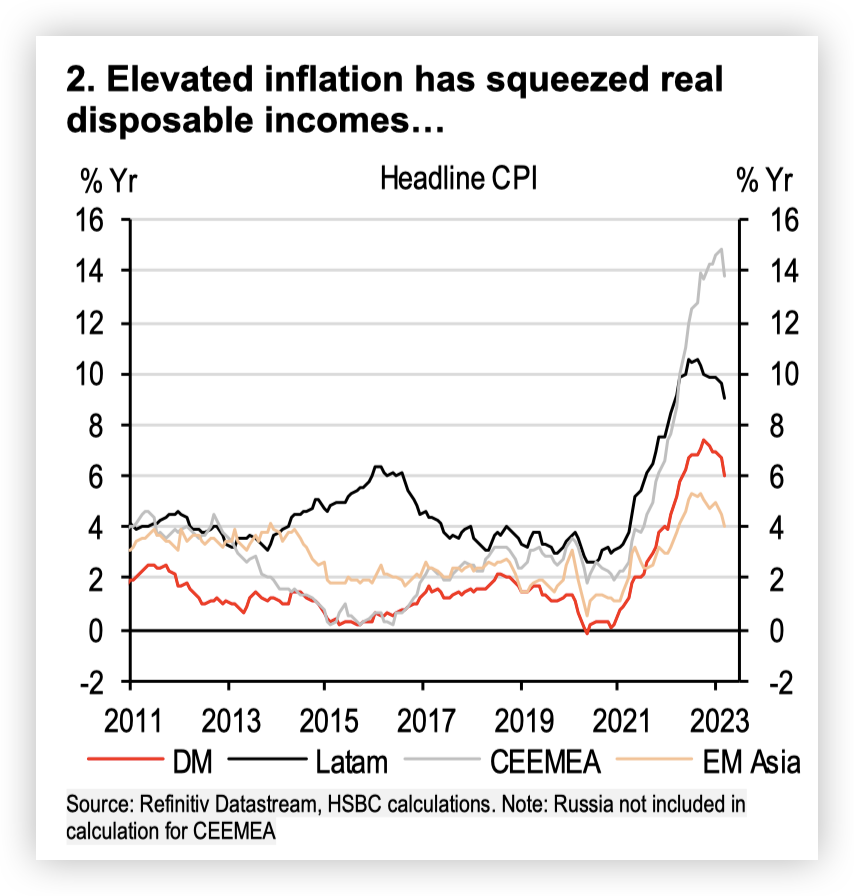

In addition, due to the violent interest rate hike initiated by the Federal Reserve in 2022,The soaring cost of borrowing has further increased the consumption pressure of ordinary families.
Analysts stressed that,Epidemic and inflation have a greater impact on low-income families, because food, housing and public utilities account for a larger proportion of their expenses., while the expenditure growth of high-income people remained stable.
Take Britain as an example. According to the data of the National Bureau of Statistics, by the end of 2022,The lowest income quintile faces an inflation rate of about 15%, but for the highest income group, the inflation rate is 11%.

Analysts also observed that,During the epidemic of COVID-19, service expenditure was greatly restricted due to the worldwide containment measures, and conversely, commodity consumption showed a prosperous scene.
With the easing of the epidemic and the relaxation of prevention and control policies, the consumption focus of many families has shifted to services again.

Analysts believe that,This may represent a broader trend, that is, the permanent shift of consumption from goods to services:
Indeed, it is still early, so with the passage of time, monitoring data will help us draw clearer conclusions. Before the COVID-19 outbreak, a survey conducted by Harris Company in the United States in 2014 pointed out that people prefer to experience rather than buy "things".
Among the respondents, 78% of millennials revealed that they prefer to spend money on experiences rather than on things, and 72% said that they intend to increase their spending on experiences in the next year.
When discussing the reasons for their preference for experience, 77% of people said that some of their best memories came from activities or live experiences, and 69% of respondents said that they believed that participating in live activities and experiences made them more closely connected with others, the community and the world.
Therefore, we can think that this COVID-19 epidemic is a catalyst, which has accelerated the general shift from commodity consumption to service consumption.
Although the shift from commodity consumption to service consumption may be one of the major trends of consumption, from the data point of view, at present,The rebound of the service industry is uneven.
In the continuous recovery of tourism, the recovery of business travel is particularly strong.
Analysts believe that as countries around the world gradually liberalize their entry control over COVID-19, the recovery of tourism should continue to advance:
With the closure of borders and the implementation of mobility restrictions, international travel will come to a standstill in 2020. But where the economy reopened, pent-up demand contributed to a strong recovery. In the United States, American residents’ overseas travel rebounded to the level before COVID-19 in the second quarter of 2022, because Americans enjoyed their holidays again. On the other hand, because the global economies have got rid of the restrictions of COVID-19’s disease at different speeds, and some entry restrictions to control the spread still exist, the recovery speed of inbound tourism is slow.
As of April 18, 2023, 150 countries have no restrictions on the COVID-19 epidemic, accounting for 68% of the countries in the world; Therefore, 32% of countries still have restrictions. With the evidence that the economy has further entered the re-opening stage, people have the desire to travel abroad, and the recovery of tourism should continue to advance.

However, at least for now, globally, inbound passengers have not recovered to the level of 2019.

It is worth mentioning that the recovery of business travel is more significant, indicating that most business people have had enough of ZOOM and Tencent meetings, or prefer face-to-face interaction.

The analyst wrote:
More than three-quarters of travel managers expect their companies to make more business trips between 2023 and 2022, while only 7% expect to cut back. Therefore, although virtual meetings will continue to exist, people have discovered its disadvantages, and face-to-face business interaction is still important.
Under the influence of home office, the recovery of public transport is slow.
Analysts pointed out that:
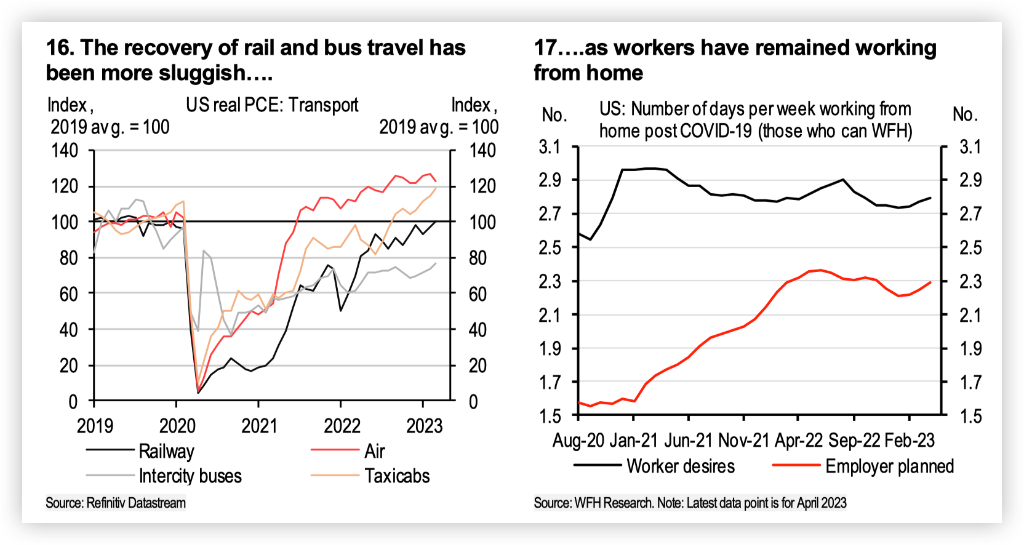
The rebound speed of railways and buses is slow, and the mixed working system may have played a great role, reducing the number of employees commuting. Because there is a gap between the number of days expected by employers and employees to work at home every week, office attendance is unlikely to rise further.
Similarly, in Britain, as it is no longer normal to work in an office five days a week, the number of passengers in London’s bus and subway services has not recovered to the pre-epidemic level. The latest data shows early signs of stability, which will indicate that the number of passengers may be permanently lower than the pre-epidemic level.
It may be difficult for the hairdressing industry to continue to prosper.
Analysts also shared another interesting observation.She pointed out that the blockade led to a higher acceptance of "more natural appearance", and many people learned to cut their own hair during the blockade, thus reducing the cost of beauty salons:
As the beauty salon was closed during the blockade, the expenditure on hairdressing and personal grooming services plummeted, and it became a common phenomenon to do it yourself. According to a report by Barclays Bank, in Britain, more than 24 million people have bought hairdressing equipment.
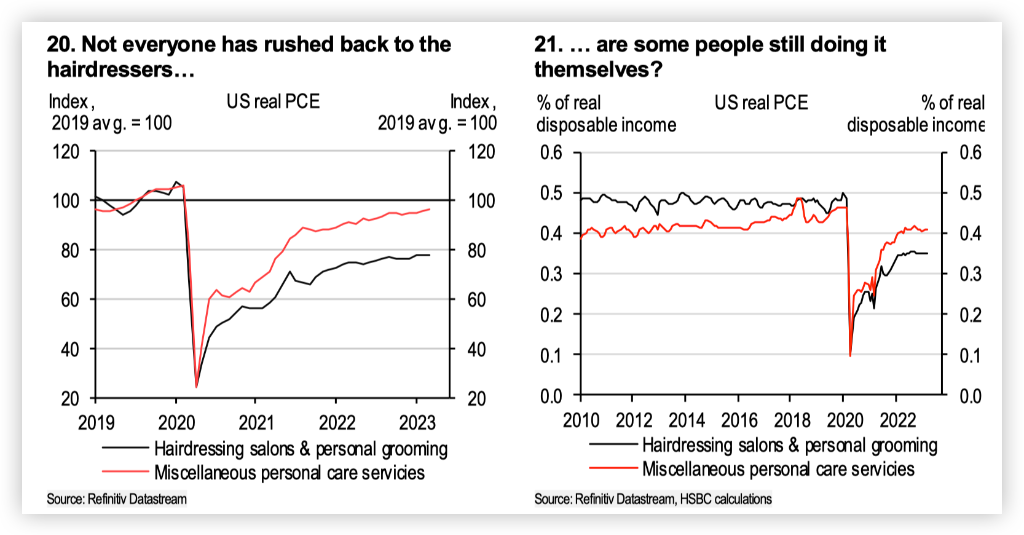
The situation in the United States is similar. As of March 2023, the actual PCE of hairdressing services in the United States is still about 20% lower than that in 2019, and its recovery lags behind the overall rebound of personal care services.
After COVID-19, people seem to be going to the hairdresser less often. In fact, Americans now spend a small proportion of their disposable income on haircuts.
The change of social attitude around personal appearance may also be a contributing factor. Kantar’s research found that when we are confined at home,People reduce the number of shampoos and makeup, and pay more attention to skin care. Therefore, it can be said that COVID-19 has given some people confidence to accept a more natural appearance and reduce the cost of related services.
Retaliatory dining promotes the recovery of the catering industry, but other entertainment industries are still in the doldrums.
Analysts pointed out that the closure of the epidemic caused people to choose "retaliatory dining" after the closure:
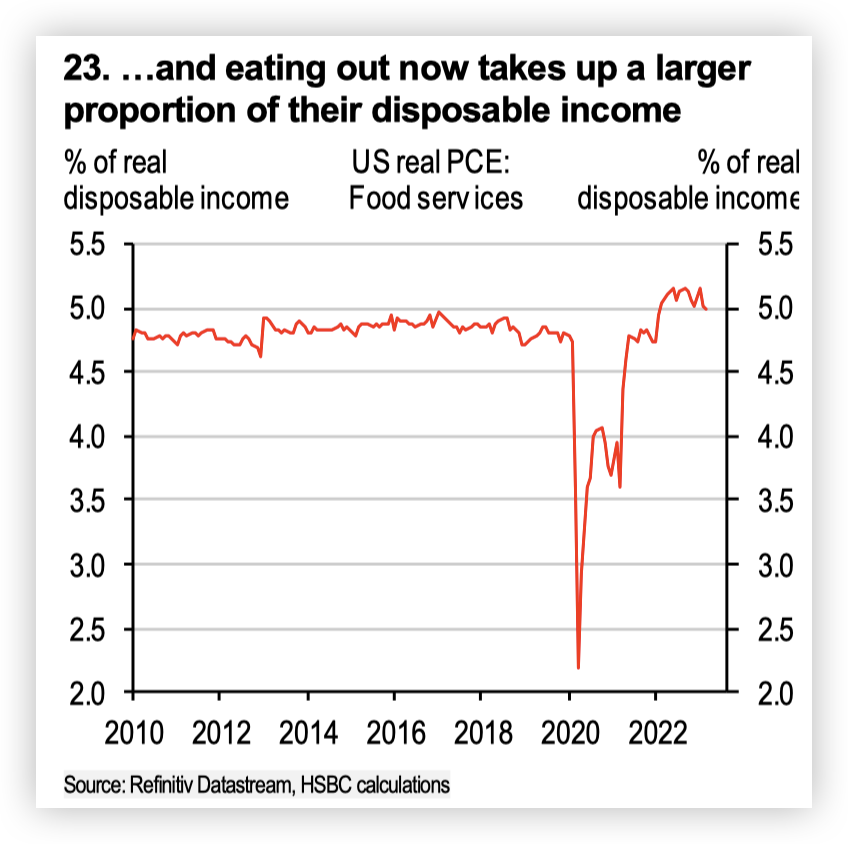
With the reopening of American restaurants, many people rushed back to enjoy the dining experience they missed during their stay in COVID-19. By the second quarter of 2021, the expenditure quickly recovered to the level of 2019 and continued to grow. Surprisingly, before COVID-19, the proportion of food service expenditure to disposable income basically remained slightly below 5%. As shown in the following figure, it has been rising since the end of the blockade.
In addition to catering, the recovery of other industries is not significant:
Different from eating out, the demand for some entertainment activities has not recovered quickly; Except for spectator sports and museums and libraries, the actual PCE of many services in the United States is still lower than that before the epidemic.
Cinemas were the hardest hit, with spending in the past three months falling by nearly 50% compared with the fourth quarter of 2019, while spending on video streaming services was more than 50% higher than that in 2019.
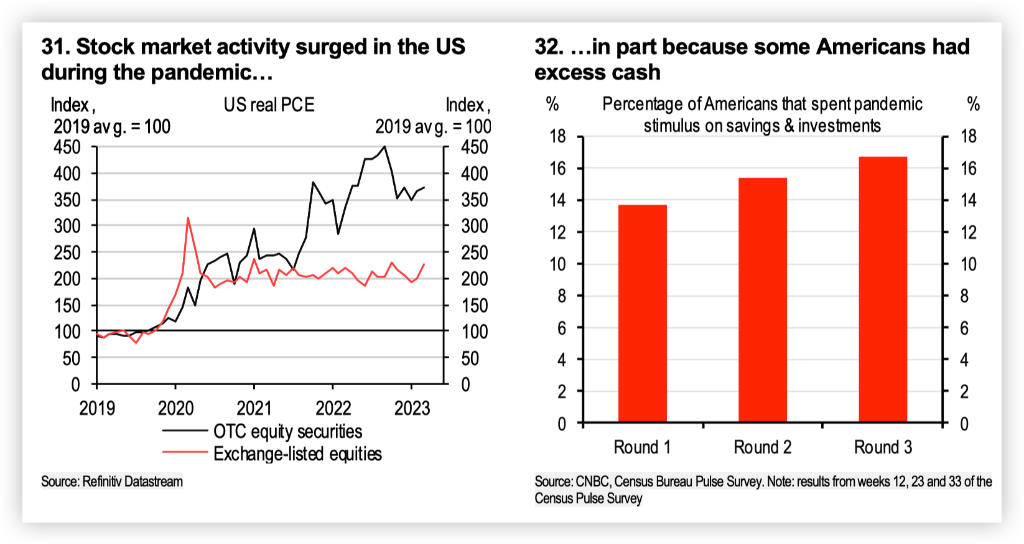
As far as the United States is concerned, during the epidemic, a more interesting change was the surge in the number of retail investors who traded stocks.
But analysts believe that this is not because the financial quotient of the American people has suddenly improved, but because:
1) the cost of buying a house increases, and buying a house is even more out of reach. It is better to stock up;
2) Sports events were cancelled during the epidemic, and some people used the stock market as a substitute for gambling.
Analysts pointed out that:
If we look at the categories with the largest growth in the United States in the second half of 2020 compared with the same period in 2019, the stock investment is among the best: the actual PCE of counter stock securities increased by 114%, and the expenditure of exchange stocks increased by 83%, partly due to the accumulation of savings.
In fact, the survey found that many Americans use the new crown subsidy for investment.The cancellation of sports events may also play a role: some people may turn to the stock market as an alternative to gambling.
The decline in housing affordability may be another factor:Maybe people are willing to take more risks now, because the prospect of buying a house has become even more out of reach.
Undoubtedly, an epidemic disease that swept the world and claimed more than 20 million lives will have a great impact on people’s lifestyle.
Analysts found that,After COVID-19, people around the world are more enthusiastic about saving, and in addition, they pay more attention to healthy living:
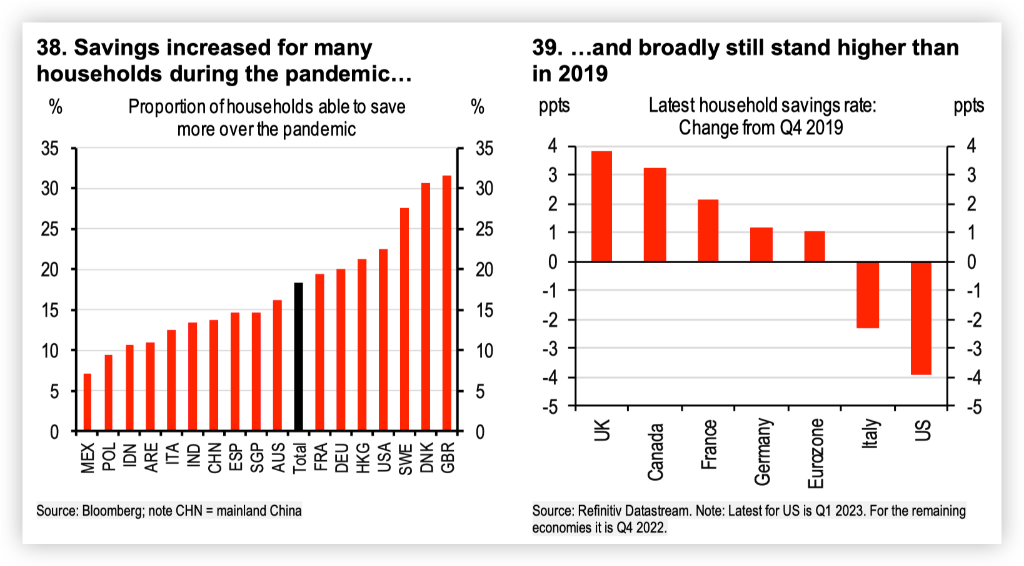
… consumption has fallen sharply in the tide of economic uncertainty. As a result, savings rates around the world have soared, and the real disposable income of many economies has been further supported by the influx of government-supported programs.
More than three years later, the household savings rate in many economies is still higher than that before COVID-19. As shown below, except for the United States and Italy, the household savings rate in several other countries is higher than that in the fourth quarter of 2019.
However, analysts also believe that it may be too early to judge whether this COVID-19’s disease has permanently increased the willingness to save:
The differences between the United States and the rest of the world paint a mixed picture. For example, American families are more willing to exhaust their savings than those in the euro zone. However, although the United States is shrinking faster, it is estimated that as of March 2023, there is still about 500 billion US dollars in excess savings in the overall economy. Therefore, although the household savings flow is lower than that before COVID-19, the savings stock is still increasing.
The pressure of the cost of living also makes it more complicated to draw a conclusion so early: the savings rate and intention have increased recently, but the challenging economic background, namely inflation and interest rate increase, may also be a great driving force.
In addition, the COVID-19 epidemic has also made many people fall in love with sports, and the days of being locked up at home have also made them cherish the time when they can go out and move freely:
According to a survey conducted by the British Heart Foundation in 2021, 20% of the respondents said that their physical fitness level improved during the lock-up, 32% thought that having more free time and the desire to go out of the house were motivating factors, and 37% revealed that they exercised more frequently for a short time.
Similarly, the Public Health Bureau of England found that 70% of adults are motivated to make healthy lifestyle changes in 2021 due to the influence of COVID-19, such as losing weight, eating healthier food and doing more exercise.
In addition, a survey of 3,500 Americans found that improving health is one of the most New Year’s goals in 2023. Health-related goals are equally common among Britons, with more than 50% saying their goal this year is to do more exercise/improve physical fitness.Therefore, if keeping healthy remains a priority for people in the future, relevant sectors in the economy may prosper.
This article is from Wall Street. Welcome to download the APP to see more.