[Editor’s note]
Under the background of entering the new development pattern of double circulation, China is accelerating the reform and opening up at a deeper and higher level. Improving the business environment of enterprises, reducing the operating cost of the market, improving the efficiency of economic operation and promoting the free flow of factors are the internal strengths that China must cultivate to enhance its international attraction and competitiveness.
Focusing on the development goal of Shanghai as an "outstanding global city", Shanghai Development Strategy Research Institute focuses on 20 international metropolises recognized as global cities in the world. Based on the functions and actual characteristics of global cities, on the basis of the global urban business environment evaluation system released in 2019, the indicators were revised and improved in 2020, and a "global urban business environment index system" was constructed, which includes 7 first-level indicators, 23 second-level indicators and 41 third-level indicators.
According to this index system, the research group quantitatively evaluated the business environment of 20 global cities, including Shanghai, Beijing, Shenzhen, Hong Kong and other cities. By benchmarking the highest international standards, China’s cities can see their own strengths and weaknesses, and put forward constructive suggestions on how to make up the shortcomings.
Based on the strategic goal of Shanghai’s urban development, if we simply use the World Bank’s index system to evaluate the business environment, we can’t really promote the promotion and optimization of Shanghai’s business environment accurately, multi-dimensionally and comprehensively. Therefore, based on extensive investigation and soliciting opinions from all walks of life, Shanghai Development Strategy Institute has put forward a global urban business environment index system that is based on Shanghai’s reality, closely follows the demands of enterprises and is conducive to accurate benchmarking.
First, the necessity of building a global urban business environment index system
At present, Shanghai should strengthen the four functions of global resource allocation, scientific and technological innovation strategy, high-end industry leading and opening hub portal, continuously enhance the city’s attractiveness, creativity and competitiveness, become a central node of domestic large-scale circulation and a strategically linked city of domestic and international double-cycle under the new development pattern, and accelerate the goal of becoming an outstanding global city. Based on the strategic goal of Shanghai’s urban development, if we simply use the World Bank’s index system to evaluate the business environment, we can’t really promote the promotion and optimization of Shanghai’s business environment accurately, multi-dimensionally and comprehensively. The main reason is that the World Bank’s evaluation scope of the business environment is limited, and the characteristic factors of the global urban business environment, such as the international high-standard market rules system, the support of high-end producer services, and the high-energy public service system, are not included in the evaluation scope, so it is difficult to fully reflect the high-standard demands of multinational headquarters and high-energy functional institutions for the business environment. Therefore, it is necessary to build a global urban business environment index system that meets the positioning needs of "global cities", the strengthening requirements of "four major functions" and the promotion demands of "attraction, creativity and competitiveness".
Second, based on the connotation characteristics of global urban business environment, build an index system supported by seven major environments.
(A) the connotation and characteristics of global urban business environment
1. The core functions of global cities
In the modern sense, a global city is the center of the global economic system or the organizational node in the world urban network system, and it is a modern international metropolis that plays a key role beyond national boundaries in global economic coordination and organization. For global cities that occupy the core position and key nodes of the global urban system, their core functions are mainly reflected in:
The first is the allocation function of global high-end resource elements.Global cities are areas where high-end elements, organizations, talents and products are gathered, and they are in a dominant position in the global economic system, giving play to the functions of gathering, integrating, radiating and leading globalization.
The second is the source function of global scientific and technological innovation.It is mainly reflected in the function of a central node in the cross-border flow, aggregation and intersection of high-end innovation resources around the world, and it has become the innovation source and innovation diffusion place of major international scientific development, original technology and high-tech industries.
The third is the function of global investment and trade hub.Effectively promote the free flow, fair trade and efficient value-added of resource elements, become the circulation center and strategic highland for efficient gathering of high-energy resources, and have a core influence position in global factor pricing rights, information release rights, technical standards rights, market leadership and rule-making rights.
The fourth is the leading function of global cultural integration.To build a new form of urban civilization that can not only represent the essence of Chinese culture, but also absorb advanced western cultural elements, and provide a platform for full display, integration, innovation and trading of various cultural forms and resources at home and abroad, and become an important area for the world’s multicultural exchange.
Fifth, the global information network hub function.Global cities are often global information network hubs, which can realize the rapid flow and barrier-free exchange of information resources on the basis of safety and credibility. They not only have strong information production, utilization and information radiation capabilities, but also have strong advantages in integrating and configuring global information resources.
Sixth, the function of global talent flow gathering.Gather and allocate influential talents who lead the trend, master resources and become incubators, accelerators and transit stations for the development of global innovative talents, and promote the effective integration and efficient allocation of global innovative talents with capital, technology and information on a global scale.
2. Functional carriers of global cities
Among all the cities integrated into the global urban network, global cities show more extensive and intensive interactions than other cities, and become strategic nodes with a decisive position in the global urban network. One of the important ways to realize this strategic function is to gather a large number of global functional institutions. It mainly includes: first, the headquarters and functional institutions of various high-energy multinational companies. Multinational companies rely on the global distribution of their business to realize the resource allocation of talents, technology, capital, information and other elements among cities around the world. The second is a hub and control platform to realize efficient interaction between the world and the region. The efficiency of the flow of capital, information, talents, technology and other factors and the platform subjects supporting the flow of factors are very important to the development of global cities.
3. Characteristics of business environment of global cities
Based on the main demands of global urban core functions and functional carriers for global urban business environment, global urban business environment has more distinctive and high-end connotation characteristics. More emphasis on the market development environment with high growth, openness and good credit; High-end and complete industrial supporting environment; Efficient and convenient infrastructure environment with global connectivity; Efficient and transparent government environment; High-end and abundant factor supply environment; A highly comfortable and high-quality livable environment; Perfect and complete legal protection environment.
First, a market development environment with high growth, openness and good credit.The allocation of global capital, science and technology, talents, information and other resources by the core functional carriers of global cities such as multinational corporations and functional institutions needs to be carried out on the basis of a highly open market environment with good market credit and certain potential. Large enough market potential is a prerequisite for enterprises to invest. The higher the level of a city in the global network, the greater its economic scale and development potential, and the easier it is for enterprises to invest. Market opening and international participation are prerequisites for enterprises to invest in cities and regions. The highly market-oriented national treatment before and after entry is the market guarantee for the smooth development and expansion of global business of the core functional carriers of global cities. The convenience of obtaining credit is the key to attracting enterprises. Multinational companies often prefer to conduct business activities in global cities that have access to credit facilities to ensure the sustainability of economic behavior.
The second is a high-end and complete industrial supporting environment.High-level industrial supporting environment can produce a huge siphon effect and strongly attract multinational companies to seek maximum benefits. A complete and high-end producer service system is an important factor to attract multinational companies and other global high-energy institutions to settle down. The core functional institutions of global cities need professional service departments including banking, insurance, accounting and law to provide high-end service support. The scale and energy level of manufacturing industry are often the key contents of multinational companies’ investment layout. Multinational companies occupy the high-end link of the value chain, so they need to focus on the manufacturing industry with high growth, high added value and key core technologies as the industrial carrier to optimize their functions.
The third is a fast, convenient and highly connected infrastructure environment.Infrastructure environment is the key factor that determines the smooth and efficient operation of high-energy functional institutions such as multinational companies. Port strength is an important guarantee for multinational companies to allocate global goods trade resources. The cargo handling capacity of the port, the ability to provide shipping services, and especially the global connectivity of the port determine the depth and breadth of multinational companies’ participation in the global goods trade market. Airport hub is an important basis for multinational companies to enhance their participation in global service trade. The stronger the hub of the international airport, the higher the ability of multinational companies to allocate global personnel flow and commodity flow, and the stronger their participation in global service trade. The convenience of local traffic is an important support for multinational companies to improve their work efficiency. Fast and convenient transportation facilities in the city will help reduce commuting cost, shorten commuting time, and help multinational companies improve the efficiency of their work and communication. Information infrastructure is an important carrier for multinational companies to enhance their right to speak in digital trade. The information infrastructure with efficient connectivity and global accessibility can promote the convenient flow of information, data and other elements around the world, thus helping multinational companies to strengthen communication and coordination with branches in the global network layout and enhance their right to speak in global digital trade.
The fourth is an efficient and transparent government service environment.An efficient and transparent government service environment is conducive to effectively reducing the institutional transaction costs of high-end enterprises and functional institutions. Multinational companies and functional organizations have higher demands on the efficiency of government services. Simple and efficient government service system can promote enterprises and institutions to reduce costs and increase efficiency. Government incentives are the key factors to attract multinational companies and functional institutions to settle in. Attractive tax and other preferential policies will greatly enhance the profitability of multinational corporations and functional institutions.
The fifth is the high-end and abundant factor supply environment.The operation of high-end functional institutions such as multinational companies needs sufficient and high-end factor supply guarantee. Human resources and office space are essential elements of enterprise operation. The operation of enterprises and institutions needs the support of high-end talents and high-grade office space. Capital financing is the core element of enterprise operation. The convenience of financing and the freedom of currency exchange affect the global allocation of funds by high-end functional institutions such as multinational corporations. Innovation ability is the key element of enterprise operation. The supply of innovative elements and the concentration of innovative atmosphere in a city are the key factors to be considered when multinational corporations research and develop their headquarters or the global layout of patent-intensive multinational corporations.
Sixth, a livable quality environment with high comfort and high quality.The main body of enterprise activities ultimately boils down to "talents", and talents pay more attention to the livability, convenience and safety of urban development when choosing employment location. Supporting social public services is the key to gathering high-end talents. High-end quality education and medical services and rich and active cultural atmosphere have a strong attraction to high-end talents. Ecological livable environment is an important factor affecting the location stickiness of enterprises. Global cities with excellent ecological quality, powerful service functions and distinctive ecological characteristics can attract more high-quality enterprises to settle in. Urban security is the basic factor to be considered when selecting talents for employment. Cities with low crime rate and low natural risk are often one of the important considerations when talents choose workplaces.
Seventh, improve and perfect the legal protection environment that conforms to the international common rules.The quality of the legal protection environment in which enterprises operate directly affects the efficiency of obtaining factors and allocating resources. Intellectual property protection is a key factor to improve the innovation level of multinational corporations. A comprehensive and internationally accepted intellectual property protection system is an important institutional guarantee to attract multinational companies to enter and encourage them to continue to provide high-end service products and continuously improve their innovation level. Contract execution is the basic guarantee for multinational companies to reduce costs and increase efficiency. The limitation of filing and concluding contract disputes, the maintenance of contract effectiveness and the strength of honest trading are related to the institutional transaction cost and efficiency of enterprises. Bankruptcy handling is an important content to protect the legitimate rights of multinational corporations. High-end functional institutions such as multinational corporations usually hope to protect the legal rights of creditors and other interested parties in bankruptcy proceedings.
(B) the difference between the global urban business environment index system and the World Bank business environment index system
Among the existing mainstream business environment assessment reports, the most representative and influential one is the Business Environment Report published by the World Bank every year. This report mainly adopts the methods of questionnaire survey and case analysis, and evaluates the "time, cost and expense" of enterprises in the four links of "start-up, expansion, operation and bankruptcy" from the perspective of enterprise’s "life cycle".
Compared with the World Bank report, the global urban business environment assessment system has obviously different characteristics:First, the purpose of evaluation is different.The evaluation purpose of the World Bank Business Environment Report is to improve the business environment of small and medium-sized enterprises and stimulate their vitality and development momentum. The purpose of global urban business environment evaluation system is to improve the business environment that meets the requirements of global urban functions and comprehensively enhance the core functions of cities.Second, the research objects are different.The world bank’s business environment assessment report studies small and medium-sized enterprises; The global urban business environment evaluation system focuses on the headquarters of various multinational companies and high-energy functional institutions.Third, the definition of environment is different.The world bank’s business environment assessment report mainly focuses on the government supervision system of small and medium-sized enterprises throughout their life cycle; The global urban business environment evaluation system not only pays attention to the government supervision system, but also investigates the comprehensive environment such as market development, industrial support, infrastructure, factor supply and livable quality that high-energy enterprises are concerned about.Fourth, the evaluation criteria are different.The World Bank’s business environment assessment report mainly evaluates the convenience of enterprise start-up from three dimensions: time, cost and expense. The global urban business environment evaluation system pays more attention to the degree to which financial openness, market transparency, investment and trade openness and other institutional systems are in line with international rules and standards.
(C) the construction of global urban business environment index system
1, the basic structure of the index system
Based on the connotation characteristics of global urban business environment, market development, industrial support, infrastructure, government services, factor supply, livable quality and legal protection are selected as seven first-level indicators, and together with 23 second-level indicators and 41 third-level indicators, the global urban business environment evaluation index system is formed (Table 1).
Table 1 Index system of global urban business environment

Source: Global Urban Business Environment Research Group of Shanghai Development Strategy Institute.
2. Selection criteria of sample cities
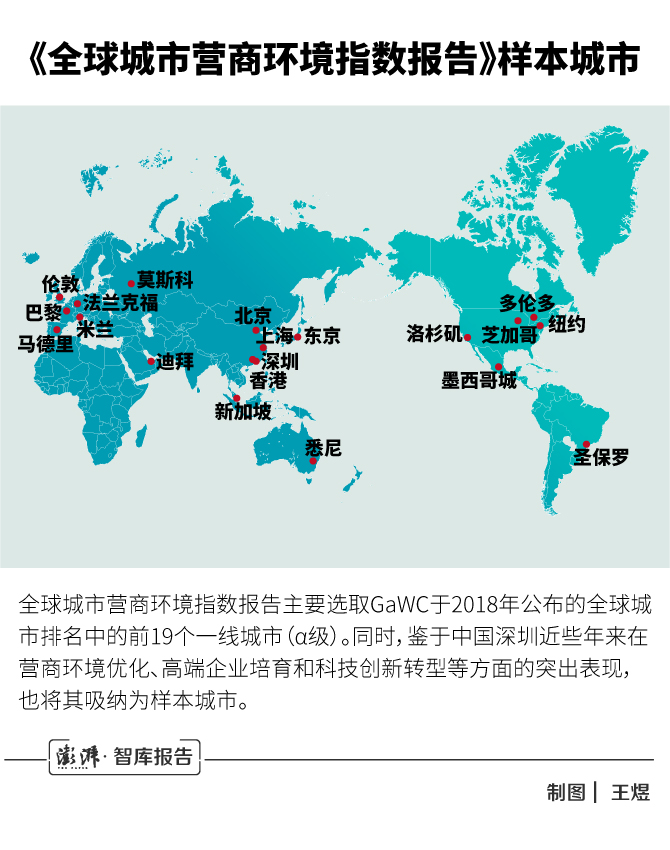
The sample cities of the indicator system mainly select the top 19 first-tier cities (α-level) in the global city ranking published by GaWC (Globalization and World Urban Research Institute) in 2018. At the same time, in view of its outstanding performance in business environment optimization, high-end enterprise cultivation and technological innovation transformation in recent years, Shenzhen, China has also been accepted as a sample city. Therefore, the 20 sample cities areLondon, new york, Hongkong, Beijing, Singapore, Shanghai, Shenzhen, Sydney, Paris, Dubai, Tokyo, Milan, Chicago, Moscow, Toronto, Sao Paulo, Frankfurt, Los Angeles, Madrid and Mexico City.(table 2)
Table 2 Basic information of 20 sample cities
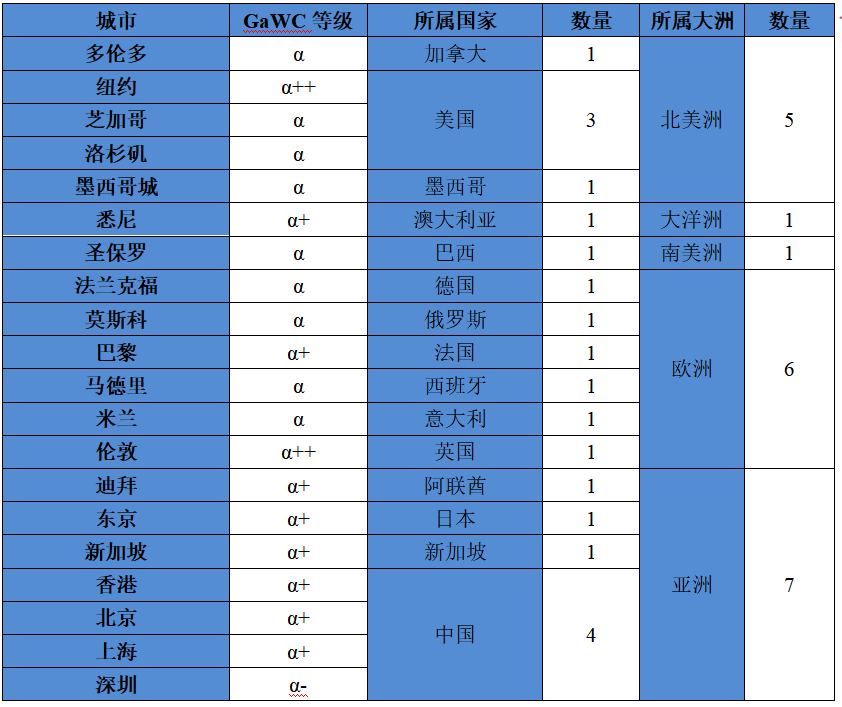
Source: Global Urban Business Environment Research Group of Shanghai Development Strategy Institute.
3. Technical methods of index system
Data authority is mainly reflected in four aspects:First, the index design reflects the characteristics of global cities as much as possible.Highlight the characteristic indicators of the core functions of global cities, such as paying attention to industrial support, especially the development of high-end services; Pay attention to legal protection, especially the "soft environment" such as intellectual property protection.Second, data is obtained through multiple channels as much as possible.The data collection of the report is obtained from the reports of the World Bank, famous think tanks and big data search. The diversity of channels can minimize the systematic deviation caused by a single data source.Third, the weight distribution follows the principle of system optimization.Through the unequal weight ratio, the multicollinearity components between indicators are reduced as much as possible, so that the whole index system can be optimized.Fourth, cross-validation is used in data analysis to ensure the authenticity and reliability of data.In data analysis, principal component analysis is used to analyze the correlation between indicators, and the data with large deviation from the actual situation can be found and corrected in time.
In terms of research methods,The research method mainly adopts the combination of expert evaluation and big data analysis.In terms of index design and weight distribution, five expert symposiums were held, and experts from high-end service enterprise managers, industrial enterprise managers, government officials, university scholars and other different fields were invited to jointly study index design and weight distribution. In data acquisition and econometric analysis, big data analysis methods are used, and dimensionless analysis, principal component analysis and other means are used to calculate and verify the city ranking to ensure the accuracy of the city ranking.